


Notícias
Tenha em atenção que as informações apresentadas são válidas no momento da publicação, mas podem estar sujeitas a alterações sem aviso prévio. Esta página mostra apenas os itens mais recentes. Para o arquivo completo dos comunicados de imprensa, clique em "Pesquisar por categoria ou ano".
Mitsubishi Electric Joins Publicly Solicited Project to Verify System for Identifying Greenhouse Gas Emission Sources
 PDF Version (PDF:438.3 KB)
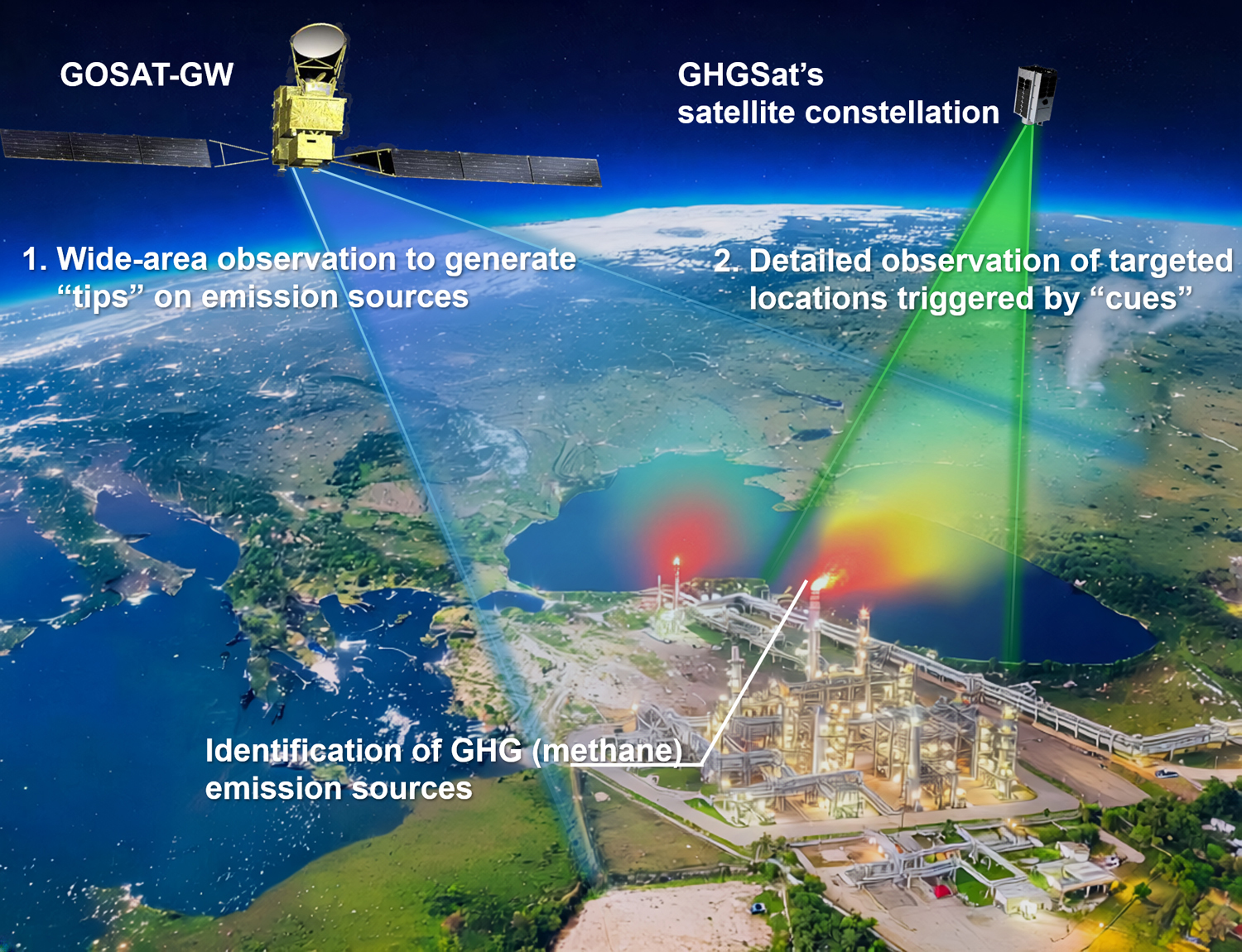
Envisioned system for identifying GHG emission sources using GOSAT-GW and GHGSat’s satellite constellation
TOKYO, June 25, 2026 – Mitsubishi Electric Corporation (TOKYO: 6503) announced today that it was selected by the Japan Organization for Metals and Energy Security (JOGMEC) as a contractor to verify technologies that use satellite data to identify and measure sources of greenhouse gas (GHG) emissions. This publicly solicited project will be carried out during the current fiscal year ending in March 2027. Following the selection, Mitsubishi Electric formally signed a contract with JOGMEC to join the project.
Mitsubishi Electric will verify the effectiveness of technologies that use satellite data to identify and quantify methane emission sources. The ultimate goal is to develop a service that visualizes emissions and provides this information to companies, local governments and other users. For the project, the company will collaborate with Satellite Data Services Co., Ltd., JGC Corporation, Mitsubishi Electric Software Corporation and GHGSat Inc., as well as leverage the expertise of MUFG Bank, Ltd., a Mitsubishi Electric partner.
Accurately understanding emission sources and volumes is critical to reducing GHG emissions and addressing global warming. Methane, the main component of liquefied natural gas (LNG) used for thermal power generation, has a higher global warming potential than CO2. In the energy sector, including LNG supply chains, there is a growing demand to identify methane emission sources, detect leaks early and improve transparency regarding actual emissions.
In 2024, Mitsubishi Electric began collaborating with MUFG Bank, Satellite Data Services and GHGSat to develop a service that visualizes GHG emissions and identifies the sources using data acquired from GHGSat’s satellite constellation and a satellite, the Global Observing SATellite for Greenhouse gases and Water cycle (GOSAT-GW1), which was launched on June 29, 2025. The companies have been studying the feasibility of a “tip & cue” operation in which GOSAT-GW, which is suited for wide-area observation, efficiently identifies areas where GHG emissions may be occurring and then provides “tips” on locations where abnormalities are suspected. Detailed observations of the targeted locations are then conducted by sending “cues” to GHGSat’s satellite constellation, which is suited for localized, high-resolution observations.
For JOGMEC’s publicly solicited project, Mitsubishi Electric will apply knowledge and expertise from its own previous studies as well as satellite data acquired with the GOSAT-GW satellite and GHGSat’s satellite constellation. The goal is to verify accurate detection and quantification of methane emissions under field conditions. The company will also determine technical requirements and operational procedures for practical implementation.
In addition, Mitsubishi Electric will evaluate the feasibility of applying satellite-based methane emission measurements to the Oil & Gas Methane Partnership 2.0 (OGMP 2.0). The partnership, led by the United Nations Environment Programme (UNEP), is a comprehensive measurement-based international reporting framework for the oil and gas industry, aimed at reducing methane emissions, improving the accuracy of emission measurements, and increasing transparency in emission reporting. Mitsubishi Electric will compile the findings for use in demonstrations and eventual commercialization. The company will also study the possibility of conducting joint demonstrations using satellite data in a top-down approach2 at natural gas and LNG production facilities.
- 1
A satellite jointly operated by the Ministry of the Environment, the National Institute for Environmental Studies, and the Japan Aerospace Exploration Agency. Mitsubishi Electric served as the prime contractor and was responsible for developing the satellite system and onboard sensors, TANSO-3 and AMSR3.
- 2
A method for measuring methane concentrations in the atmosphere on a macro scale using satellites, ground-based observation stations and other observation tools. In contrast, a bottom-up approach measures methane leakage volumes at individual facilities or equipment and aggregates the resulting data.
Inquiry
-
Customer Inquiries
Defense & Space Solution Division
Defense & Space Systems Group
Mitsubishi Electric Corporation